
|

|
|
|
|

|
|
|
|

Central Trains Railtrack Health & Safety Executive British Transport Police
Seven days . . . . . . web focus on rail safety and accidents in the last week |
|||
Safety at occupation level crossingsfrom our Safety Correspondent : Monday, November 1, 1999The accident on 29 October at Llanbrynmair Crossing in Powys in which an American woman was killed and her husband seriously injured raises issues regarding the public's attitude
In much of Britain level crossings are usually guarded by signals and barriers and it is not until lines traverse rural areas such as in the Highlands and in Central Wales that the occupation crossings become commonplace. The Cambrian line between Shrewsbury and Machynlleth follows the upper Severn valley as far a Caersws and then climbs over the foothills of the Cambrian Mountains to a summit at Talerddig before dropping to near sea level at the Dovey Estuary. The entire line is rural with small roads, farm access tracks and footpaths crossing the line throughout its length. These see only spasmodic or seasonal use and it is uneconomic to contemplate barriers. However, many are fitted with telephones with which the crossing user can seek permission to cross from the signalman in Machynlleth. The Cambrian Line is mostly single with passing places on the 59 mile eastern section at Welshpool (18 miles), Newtown (32 miles), Talerddig (45 miles) and Machynlleth. There is only one signalbox on the whole line - at Machynlleth and apart from a short section at that location, no signals. Trains are controlled by radio and as result the signalman only has "visibility" of train location at the passing points. The line speed is 85mph. 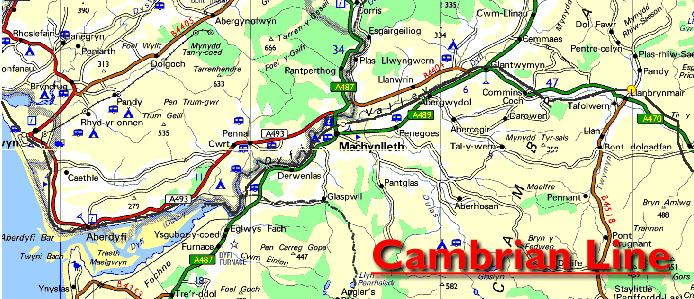 To the crossing user the crossing just 5ft of rail track is not something which should cause him any hassle. However, using the telephone for permission to cross can result in await for up to 10 minutes. This is because the signalman cannot accurately locate any train in the locality and indeed in some cases the user can be told to wait for a train which is already past the crossing. This leads to frustration, refusal to use the telephone and in some cases failure to close the gates. What is needed is an improvement in the attitude of the public towards the disciplines required to maintain safety. This can only be achieved if the railway, in turn, gives something back in the form of sensible and accurate decisions as to the length of the wait. This can only be done if the exact location of each train is known and it should not be beyond modern technology to devise a system by which this could be provided. It is a matter of trust. Trust that an instruction to wait two minutes is two minutes not ten and that permission to cross will not result in the user being struck by a train. Only when this trust is established will the safety of occupation crossings be improved.
|




|
 This file last updated: Monday, 01-Nov-1999 14:12:17 EST