
|

|
|
|
|

|
|
|
|
YAHOO Full Coverage Chronology of Rail Accidents in Norway Norwegian State Railways
Seven days . . . . . . web focus on rail safety and accidents in the last week | |||
NORWAY:
NSB : 05 January, 2000
|


|
|
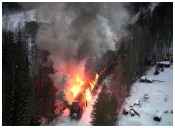
The train 2302, departure time from Trondheim 07.45 and arrival at Hamar 13.50 consisted of Di 3 625 engine and two B3 + BF11 carriages.
The trains would normally pass each other at Rustad station at 13.10. Both trains were manned by one driver and an on-board conductor.
NSB estimate that there were approx. 100 persons involved in the accident, but this figure has not been confirmed at this time.
General
All material involved has been
maintained in accordance with applicable regulations.
NSB has no reports on delayed or postponed maintenance routines or safety-critical
faults on the material.
The trains were equipped with ATC, but the permanent plant along this stretch
of track on the Røros line is not equipped with this system.
All carriages including the engines are equipped with fire extinguishing
equipment.
Rolling stock specifications
BM-92-14, delivered in 1985. Constructed in accordance with the then current fire regulations for rolling stock for the German State Railway / Germany and other European countries.
DI-3, delivered in 1965. This
type of locomotive is a 1950’s model and is still in use in large numbers
around the world. There were no special fire regulations for rolling stock
in force at that time.
The locomotive is constructed in accordance with the then current American
Standard.
B-3 carriages. The carriages, which were delivered in the 1960’s were constructed in accordance with the then current standards standard.
Tank capacity
Maximum
tank capacity of the diesel tank of DI-3 is 3,500 litres.
For BM-92 the maximum capacity is 1,600 litres.
According to our preliminary calculations the total volume of diesel could
be in the region of 3,500 litres.
Use of mobile telephones
It
is a fact that all trains are equipped with mobile telephones and that these
telephones can be reached from the train management centres. Whether or
not there has been a lack of clarity concerning the use of mobile telephones
and the degree to which this may have had any bearing on the accident are
among the matters that will now be investigated by the Railway Authority’s
Accident Commission and NSB’s Accident Commission.
Short description of SAFETY SYSTEM, ATC and CTC
SAFETY PLANT
There shall
never be more than one train on a single track or stretch of track at the
same time. The safety system shall prevent two trains both receiving a green
light for the same single track or for the same stretch between stations
at the same time. It is the safety system that furnishes the technical safety
aspects.
ATC means automatic train control and is a technical system that monitors among other things that trains do not accidentally pass through signals set at stop (red) by the safety system on the track /stations. The system is composed of a combination of technical devices in the infra-structure which operate independently of the safety system installation on the track and the equipment onboard the train. The rolling stock involved in the accident was equipped with this system but the infra structure is not. The total system was therefore not equipped with ATC.
CTC(Central Traffic Control) is a technical system for the remote control of stations (points changers and signals) from a central operations unit (in this case from the Hamar train operations control centre) and ensures that correct signals are given and tracks allocated for trains on the stretch controlled.
Communications
Train
radios are not installed on the Røros Line, and the train drivers
communicate with the operations control centre via a dedicated closed circuit
telephone system train management that is installed at all main signals.
Additionally, all trains are equipped with NMT mobile telephones. Mobile
telephones are the only method of communication for trains under way on
the Røros line. Calls are logged at the train operations control
centre, not onboard the trains.
Safety regimes
NSB
run trains in accordance with the Railway Authority’s regulations and
in accordance with instructions from the Railway Authority’s operations
control which administrates traffic. Separate regulations in NSB will always
be based on the Railway Authority’s regulations.
The Railway Authority’s Accident Commission
The
Railway Authority has an accident commission that investigates serious accidents
related to train operations occurring on the national railway network. NSB
has placed experts at the disposal of the commission. The commission is
led by Traffic Safety Director Ove Skovdahl.
NSB’s Accident Commission
NSB
has established its own accident commission. The commission shall investigate
all serious accidents and near accidents related to traffic safety and train
operation. The commission operates under the auspices of the NSB’s
Traffic Safety Manager Helge Holtebekk. Investigative work is led by the
Safety Manager of NSB Operations and Technical Dept. Svein Ivar Johannessen.
The results of the commission’s work will be made public when the commission’s
task is finished.
Operating conditions
NSB’s
train drivers are subject to comprehensive training and work in strict accordance
with regulations relating to safety, operational working hours and rest
periods. Personnel are monitored by line management in co-operation with
the Safety Office of the Operations and Technical Dept. In addition to the
regulations issued by the Railway Authority, separate procedures have been
developed by NSB that govern the train driver’s and on-board staff’s
work. Contingency plans have been prepared. Operative management of personnel
and the initiation of contingency plans are managed by the Operations Management
Centre (established in Oslo and Trondheim).
Train operations on Wednesday 05.01.
The
Operations Management Centre in Oslo issued the following bulletin concerning
traffic operations on the Røros line.
The Dovre line and other stretches are under normal operation.
Traffic past the site of the accident is being effectuated by bus and taxi. This solution is envisaged to be in operation for the whole 24 hour period of Wednesday 05.01.
Passengers are as a general rule transported by bus/taxi on the stretch Hamar – Rena – Koppang in both directions. Trains are in operation in both directions between Koppang and Røros.
Source: NSB (Norwegian State Railways)

|
 This
file last updated: Monday, 10-Jan-2000 21:15:36 EST
This
file last updated: Monday, 10-Jan-2000 21:15:36 EST