




Accidents
Currents
Features
Gallery
Books
Links
Site Map
Help
Search
Bibliography
Glossary


Legacy of the Great Race North
Preston station, 15 August 1896...
An effect of the Train Races of 1895 was that the timetables for both the east coast and the west coast routes to Scotland contained some very exacting schedules. During that summer, the men employed on driving the trains did so on their "own" engines and with experience became well versed in shaving precious seconds off their times. By the following year, with the races behind them, the London and North Western Railway reverted to its practice of allocating any available men to any available engine and then allocating that combination to the next train requiring motive power. It was thus on the night of 15 August 1896 when the 8.00pm Down Highland Express was due to leave London, Euston. It was the height of summer, the grouse shooting season was just three days old and the tourist season was in full swing. Additional trains were being run and were often heavily loaded.
| Winning the Great Race North |
|---|
| The summer months of 1895 were the time of the "great race north". The competition between the east coast and the west coast routes produced some increasingly fast runs as the drivers of the trains involved pushed their steeds to the limits of their capabilities. On both lines, the track was laid and maintained to the exacting standards required of mainline railways and on straight sections without junctions some very high speeds could be attained with perfect safety. Important though this was, it was not on these sections that the greatest driving skill was required, nor was it where a race would be won. The skill and the potential laurels came from the manner in which obstacles could be negotiated. The bends and the junctions provided the real testing ground of the men and their machines. It was here, that precious seconds could be saved by pushing safety margins to the limit! |
The 8.00pm was an express train consisting of sleeping cars with a weight of something less than 200 tons. The motive power allocated consisted of two locomotives. The pilot locomotive was No. 2159 Shark and the train engine was No. 275 Vulcan. These were both three cylinder compound engines. The two outside high pressure cylinders drove the rear pair of driving wheels and the inside, low pressure cylinder drove the front pair. The two sets of driving wheels were not coupled and the engines were prone to slipping, particularly under a heavy load. They were both six-wheelers with each pair of wheels set rigidly into the frame. Between them, the engines could comfortably manage a load in excess of 300 tons and this train posed no real problems for them.
The schedule for this train called for an average speed, in places of almost 60 mph (100 Km/h) and importantly it was not scheduled to stop at Preston. Both drivers were competent, experienced men, but neither had taken this train previously and neither had at any time driven through Preston station without stopping.
Preston station is awkwardly situated. From the south, the the train had to negotiate a reverse curve bringing it into the down platform. Beyond that the line passes through a goods yard which is approached by a very sharp left-hand curve. Here, a speed restriction of 10 mph was in force. This seems to have been widely ignored. Speeds through the curve of 20 - 25 mph were often recorded. Clearly, the limit imposed allowed a margin of error which was necessary at a time when locomotives were not equipped with speedometers.
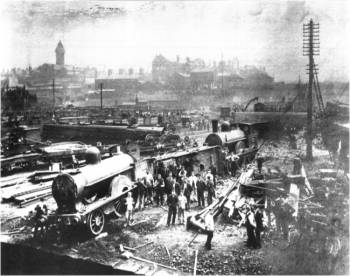 Mayhem at Preston Station 1896 Photo: PRO |
The investigation into the crash was undertaken by Col. York. His report made very little comment other than to point out the obvious cause of the accident
The cause of the accident is clear. A reverse curve without any intervening tangent, without a heck rail, with superelevation suitaable only for very low speeds, and badly distributed, and with a radius at one point of only seven chains1; a train drawn by two engines each having a rigid wheelbase of 15ft 8in.; and lastly a speed of 40 mph or more or more form a combination of circumstances which were almost certain to lead to disaster.2This accident had a profound effect on the public perception of railways and speed. During the races of the previous year, the railway companies had become used to calls from a minority that the accelerated services were dangerous. Fired with their successes, the companies had paid no heed. Now however, they took notice and there began a long period where the Anglo-Scottish services were slowed down. Little or no advance in timings was made until 1932.
The Need For Speed
Introduction to the series of articles about accidents whose underlying cause was excessive speed.
Other accidents include:
Salisbury (1906), Modane, France (1917), Aylesbury (1904)
1 A chain is equivalent to 22 yards
2 Quoted in Nock p.78
 Top
Top
 Contents | Index of Articles | Recent Reports | Post Office | Links | Site Map | Guestbook | E-mail
