




Accidents
Currents
Features
Gallery
Books
Links
Site Map
Help
Search
Bibliography
Glossary

Lagny-Pomponne - 1933

Summary
Lagny, France 23 December 1933. The Paris - Nancy train had been severely delayed due to the foggy conditions that prevailed that evening. Near Lagny, about 17 miles (23Km) from Paris, the Strasbourg express having overun signals, ploughed into the rear of the Nancy train. The resulting carnage was one of France's worst rail disasters.It was a cold and frosty evening on the Saturday before Christmas 1933 and there was a heavy fog around Paris. Traffic out of the Gare de l'Est was chaotic due to the weather as well as the special trains that were being run to cope with the extra passengers getting away and taking advantage of the prolonged break provided by Christmas day falling on the Monday. The Nancy train was two hours late departing and it encountered further delays due to several signal checks as it made its way through the congested Parisian suburbs. It was just starting away after yet another stop when the accident occurred.
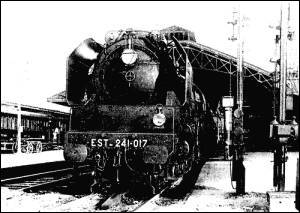 The express bound for Strasbourg was being hauled by locomotive 241.017 (4-8-2) a Mountain engine and one of the largest locomotives on the French railway system. Signals had been set to protect the Nancy train. A combination of darkness, fog and signals that were only dimly lit by oil lamps made it difficult for drivers to spot which aspect was being displayed. Neither tractionaire (driver) Daubigny nor his fireman Charpentier seem to have noticed that caution signals and a danger signal were set against them. At this time a type of AWS (Advance Warning System) was in use which consisted of a contact under the locomotive through which an electric current could be passed to operate an audible warning in the driver's cab. At distant (warning) signals a ramp was placed between the rails which was electrified when the signal was set to caution. As a locomotive passed over the ramp, its AWS equipment made contact with the ramp, thus providing the driver with a positive indication that the signal was against him.
On this occasion however, the system seems not to have been effective and the train went on oblivious to the slower train ahead. The 4-8-2 struck the rear of the Nancy train at some 60 mph (100kmh). The wooden construction of the Nancy coaches were no match for the combined energy of the mass of the locomotive and its speed. The impact demolished the majority of these coaches, killing 230 passengers and injuring 300.
It was felt that a build-up of ice on the AWS ramp may have prevented correct operation of the equipment. Driver Daubigny was prosecuted for manslaughter, but was acquitted. The railway company "Compagnie de L'Est" was required to pay compensation to the victims in the amount of 43,856,000 Francs and 29 centimes! As a final touch of irony, the express train's lcocmotive was later repaired and returned to service and was promptly nicknamed by Paris enginemen La Charcutiere (The Pork Butcher)!!!
M. Phillipe _, Paris has also supplied details of another ironic twist associated with this disaster
The famous swindler Stavisky, about to be arrested by the french Police, attempded to disappear in this accident. He sent one of his accomplices to Lagny, in the night following the crash. This man had the mission to put Stavisky's official papers on an unidentifiable body... The police should believe Stavisky died in this accident. But at night, at Stavisky's home, his house wife met him, and his diabolic plan collapsed! Stavisky decided to commit suicide a few days later, but some still said that was not a suicide, but a crime. But this is another story!
Comment
Acknowledgements
Grateful thanks to Phillipe _, Paris, France for additional material for this item
|
Help Wanted The details provided here about the accident at Lagny, 1933 are limited. If you have any information about the incident, I should be pleased to hear from you. In particular, details of the locomotive involved (eg its number) and the AWS equipment employed would be very helpful. I would also welcome any relevent pictures Please send email to davidfry@railfan.net |
 Top
Top
 Contents | Index of Articles | Recent Reports | Post Office | Links | Site Map | Guestbook | E-mail
