

| |
  |
Holland's worst disaster Harmelen, Netherlands, 1962 |
|
Harmelen, 8 January 1961 Dolf Wiertzema  |
|||||
| the worst disaster in Dutch railway history occurred at Harmelen on 8 January 1962 | |
Railway lines where bi-directional running is permitted are inherently dangerous. For this reason, on single lines very complex arrangements are put in place to control traffic and ensure that two trains do not meet each other coming from opposite directions. Such arrangements include train orders, staffs or tokens and on today's modern railways, electronic tokens. These provide a double check on a train's movements.For not only must a driver obey signal indications, he must also be in possession of the correct authority before proceeding onto a section of single track.. On double-tracked lines, each track normally carries traffic in one direction only. Thus, any danger of a head-on collision is eliminated. However, there are occasions where running on the "wrong" line is permitted. In these situations the checks used on single lines are not present. Only the normal signals exist to prevent trains coming together. It is essential that drivers taking trains over these stretches of track exercise the utmost caution with regard to sighting signals. It is common, at junctions where high speeds are to be maintained for them to be engineered to avoid diamond crossings. Layouts are installed which require a train to transfer to the opposite running line before branching off onto another line. Because of their step-like appearance they are sometimes referred to as "ladder junctions". Just such an arrangement existed at Harmelen. Here, the line from Amsterdam leaves the mainline between Rotterdam and Utrecht. For a short distance, Amsterdam trains crossed over from the eastbound line to the westbound line before being diverted onto the Amsterdam line. It was shortly before twenty past nine in the morning of Monday January 8, 1962 when a train bound for Amsterdam was snaking through the junction. Consisting of two electric multiple units it was moving at about 45 mph. The manouvre was protected from oncoming train by a red signal on the approach to the junction from the Utrecht direction. A Utrecht to Rotterdam express train, headed by an electric locomotive, No. 1137 and travelling at about 60 mph was approaching the junction. Perhaps because of the foggy conditions, the driver missed a yellow light warning that the next signal was at red. It must have been at the last moment that he saw the danger signal. The driver applied the brakes but there was nothing more that he could do. Collision was inevitable.
Between them, the trains were carrying about 500 people. A total of 91 of them including the drivers of both trains lost their lives. The Harmelen accident acted as a catalyst which spurred on the search for an automatic train control system. Development of such a system had begun in 1954. The system which was eventually installed on many lines in Holland is called Automatsiche TreinBeinvloeding. It operates by collecting signals from line-side apparatus and will overide the driver's controls in the following situations: a) failure to brake for a red signal (ATB makes an immediate brake application)
|
||||
|
||||||
 This file last updated: Sunday, 19-Mar-2000 17:58:58 EST
 Accident at Harmelen, Netherlands
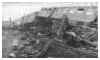 Images from the accident at Harmelen
 Top
Top