

|
|
 
|
Braybrook (Sunshine) Junction Victoria, Australia 1908 |
|
many irregularities in the signalling procedures at Braybrook
|
|
Easter tragedy in Australia

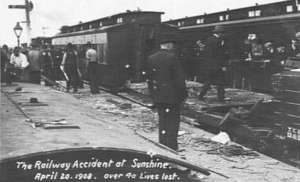
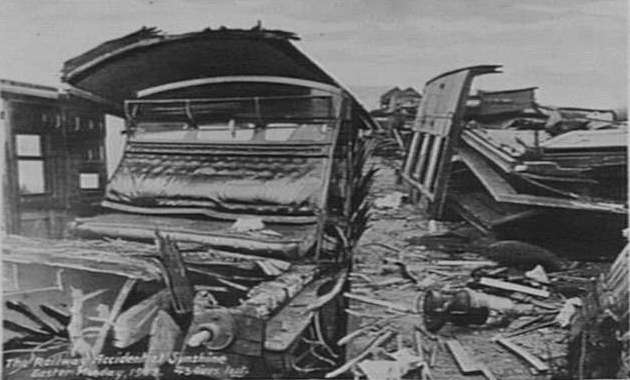
The station at Braybrook, also known as Sunshine formed a Junction where the lines to Melbourne met from Ballarat and from Bendigo. It was late at night on Easter Sunday 1908 as a train from Ballarat started from the station bound for Melbourne. A train from Bendigo was being double headed as it approached Sunshine on the falling gradient. The train swept into the station and collided with the rear of the first train. The wooden carriages offered little resistance to such an onslaught and the last five coaches of the departing train were completely destroyed.
Among the signalling irregularities was the fact that the Stationmaster at Sunshine accepted the Bendigo train under full line clear. This then obliged him to keep the track ahead of the Bendigo line home signal clear for 440 yards. He then broke the rules by bringing the Ballarat line train into the platform. If he had properly accepted the Bendigo train under the 'Section Clear but Station or Junction blocked', the Bendigo train would have been stopped at the previous block post and the Driver warned of the state of track. He may have then approached the Sunshine more cautiously. But the Driver admitted seeing the Distant signal at Caution, and acknowledged that he should have (and could have) stopped at the Home signal. The brakes on the Bendigo train were working at the previous stops on the line. Eye witness accounts at Sunshine show that the brakes were working during the accident ('rings of sparks' around the wheels). Almost no damage was done to the Bendigo train in the accident, and a series of tests were performed to investigate the trains braking performance which showed the brakes were working after the accident. However, in the driver's defence, it should be noted that the travel of almost all brake cylinders were well outside the specifications significantly reducing the available brake power. The eventual conclusion was that the Driver over ran the home signal. Reading the coroner's report, I suspect that the Driver simply 'read through' the signals. The starting signal (which was high and well focussed) was at clear for the Ballarat train in the platform. The Home signal, at stop, was low and not well focussed. The Driver commenced braking late (probably when the Ballarat train started to move), and with the weak braking power, simply couldn't pull up in time. The large death toll (the greatest in an accident in Victoria) was primarily due to the weak construction of the carriages in the Ballarat train. Both trains were specials, run on the last day of the Easter holiday to convey people back to Melbourne from visiting friends and relatives. The destroyed carriages were very elderly wooden bodied stock which simply shattered on impact (as the photo shows). None of the Drivers, nor the stationmaster were actually tried for the accident. |
||
|
||||
 This file last updated: Tuesday, 08-Feb-2000 14:02:15 EST

 Top
Top